Choosing the right Vision Correction Lenses is more personal than comparing prices or selecting the thinnest option. Your prescription, daily routine, eye health, and frame shape all influence the final result. A lens that feels comfortable during office work may perform poorly during night driving.
Start with a current eye examination from a qualified optometrist or ophthalmologist. Accurate measurements support clearer vision and safer lens selection. Discuss astigmatism, dry eyes, light sensitivity, and previous difficulties with glasses. These details can change the recommendation. Small differences matter.
Think about your real day. Do you spend eight hours facing a bright monitor? Do you move between indoor rooms and strong sunlight? Do you need one pair for reading and another for distance? Anti-reflective coatings can reduce distracting glare, while photochromic lenses may help with changing light. However, no coating solves every visual problem.
Material also deserves attention. High-index lenses can reduce thickness for stronger prescriptions, but they may cost more and show reflections without proper coating. Polycarbonate lenses offer impact resistance and lighter wear, although some users notice visual distortions around the edges. The best choice is rarely universal.
Ask your eye-care professional to explain the advantages and limitations clearly. Reliable advice should include prescription accuracy, fitting measurements, lens durability, warranty terms, and expected adaptation time. Be cautious of claims promising perfect vision for everyone. They sound convenient, but real eyes are more complicated.
Even careful shoppers can overlook comfort. A frame may look excellent yet press against the nose after several hours. Review the recommendation, test practical options, and allow room for informed reconsideration. Good Vision Correction Lenses should support your lifestyle, not merely correct numbers on a prescription.
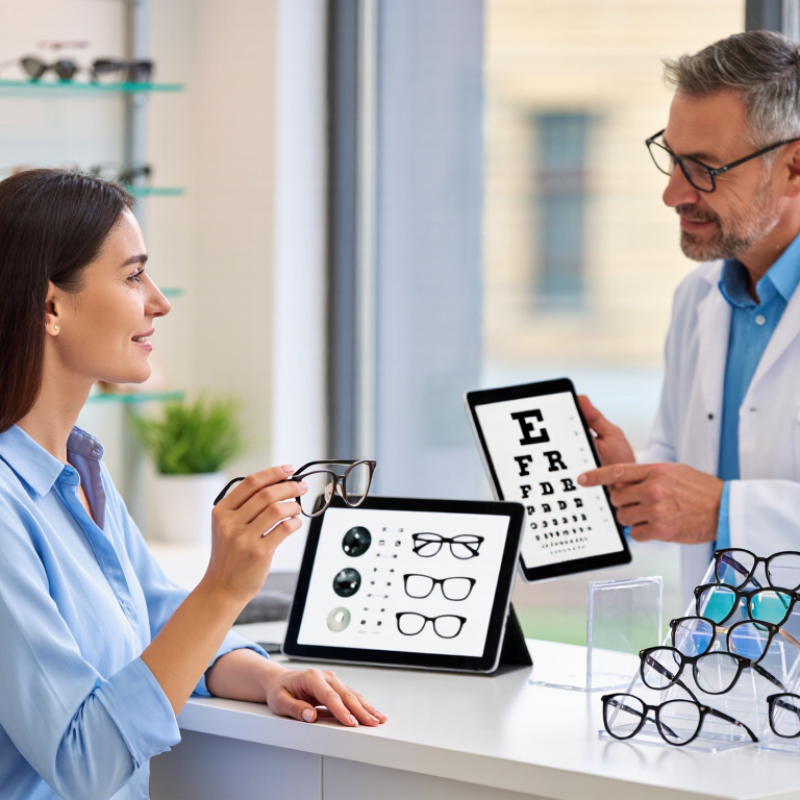
Choosing vision correction lenses should begin with your actual visual needs, not a fashionable frame or a quick online quiz. The World Health Organization’s 2019 World report on vision states that at least 2.2 billion people live with vision impairment worldwide. At least 1 billion cases could have been prevented or remain unaddressed. Refractive errors are a major contributor, but the right lens depends on how and where you use your eyes.
Think about your daily scenes. Do road signs blur at dusk? Does small text become tiring after an hour? Do screens leave your eyes dry? A comprehensive eye examination can measure distance vision, near vision, astigmatism, and age-related focusing changes. The International Agency for the Prevention of Blindness reports that uncorrected refractive error remains a leading cause of avoidable vision loss. That makes professional testing more reliable than guessing from symptoms alone.
Lens materials and designs should match your prescription, work, and safety needs. Anti-reflective treatment may help with glare, while impact-resistant materials can suit active environments. Progressive lenses can support changing focus, though adaptation is not always immediate.
My own practical mistake would be choosing convenience before comfort.
A prescription is only one part of the decision. Mention headaches, night-driving difficulty, or fluctuating vision to an eye-care professional, because these details may change the recommendation. Needs can change. Recheck them.
Choosing vision correction lenses starts with the prescription, but material affects comfort, appearance, and visual quality. In real fittings, I have seen people choose the thinnest option without considering daily use. That decision can create unnecessary reflections or color fringes.
1.50 CR-39 offers dependable optical clarity and usually the lowest cost. It works well for mild prescriptions and full-rim frames. However, it is thicker and heavier than newer materials. It also provides less impact resistance, so active users may need another choice. Keep this in mind.
1.59 polycarbonate is light, impact-resistant, and useful for children, sports, and rimless designs. Its main weakness is lower Abbe value, which can produce slight color edges near the lens perimeter. Some wearers notice this when looking sideways. Others do not. Accurate measurements and quality anti-reflective treatment can improve the experience, but they cannot remove every limitation.
1.74 high-index material can significantly reduce thickness in strong prescriptions. It may make a large prescription look cleaner and feel less bulky. Yet it often costs more and can show stronger reflections without suitable coatings. It may also provide less optical comfort for some sensitive wearers. A smaller frame can sometimes reduce thickness more effectively than changing materials. An eye-care professional should compare prescription strength, pupillary distance, frame shape, lifestyle, and safety needs before recommending one. The “best” lens is not always the thinnest one.
Refractive index indicates how efficiently a lens bends light, so higher values can help reduce thickness in stronger prescriptions. Abbe value is related to chromatic dispersion: higher values generally mean less color fringing. Density affects lens weight. The figures shown are typical material values and may vary slightly by formulation and manufacturer.
Choosing vision correction lenses is not only about prescription strength. Frame geometry matters just as much. The World Health Organization reports that at least 2.2 billion people worldwide have near or distance vision impairment. At least 1 billion cases could have been prevented or remain unaddressed, according to its World Report on Vision.
ANSI Z80.1 provides professional benchmarks for prescription ophthalmic lenses. It addresses optical power, cylinder, axis, prism, material quality, and dimensional tolerances. Ask your optician to verify these values before dispensing. The numbers matter. A small axis error may create blur, eye strain, or headaches, especially with astigmatism. Yet ANSI compliance alone does not guarantee comfort.
Fit completes the measurement. Pupillary distance should align each pupil with the lens optical center. Vertex distance, pantoscopic tilt, and frame wrap can change effective power, particularly in stronger prescriptions. A frame that slides down may quietly alter the viewing position. That detail is easy to miss. The Vision Council’s consumer research consistently shows that eyewear remains a routine part of daily life for most adults, increasing the importance of accurate fitting. I have seen accurate prescriptions feel wrong because the frame sat unevenly. Recheck the fit after adjustment, and question any lens that feels “almost right.”
| Data Dimension | Typical Data or Range | How to Match the Prescription and Frame | Optical Quality and ANSI Z80.1 Consideration |
|---|---|---|---|
| Sphere Power (SPH) | Positive power for hyperopia; negative power for myopia. Prescription steps commonly use 0.25 diopter increments. | Use the exact prescribed sphere power. Higher minus powers generally benefit from smaller lens openings and a frame that keeps the eyes centered. | The finished lens should be verified against the prescription using the applicable ANSI Z80.1 power-tolerance requirements. |
| Cylinder Power (CYL) | Corrects astigmatism and is written in plus-cylinder or minus-cylinder form. | Confirm whether the prescription uses plus or minus cylinder notation and ensure the laboratory transposes it correctly when needed. | Cylinder power and the related spherical equivalent must remain within the applicable finished-lens tolerances. |
| Axis | 0° to 180° for the orientation of astigmatic correction. | For stronger cylinder powers, accurate monocular PDs, stable frame adjustment, and careful lens marking are especially important. | Axis accuracy should be checked during lens verification because small axis errors can noticeably affect visual comfort in higher-cylinder prescriptions. |
| Add Power | Additional near power for multifocal or progressive lenses, commonly written as a positive value. | Use the prescribed add power and provide accurate fitting height for each eye. Do not substitute a reading power without professional confirmation. | Verify the near reference point and add power according to the lens design and applicable ANSI Z80.1 tolerances. |
| Monocular Pupillary Distance | Separate right-eye and left-eye measurements, recorded in millimeters. | Prefer monocular PDs for high prescriptions, progressive lenses, and frames with different right and left eye positioning. | Correct horizontal centration reduces unwanted prism and helps the finished lenses meet optical performance requirements. |
| Fitting Height | Vertical distance from the deepest point of the frame eyewire or fitting reference to the pupil or design reference point. | Measure with the frame adjusted on the wearer in the intended wearing position. Recheck after frame adjustment. | Critical for progressive and multifocal lenses; inaccurate height can shift clear-vision zones even when power is correct. |
| Frame Eye Size and Shape | Frame measurements are commonly expressed as eye size, bridge size, and temple length in millimeters. | Choose a frame that places the pupils near the geometric centers and avoids excessive decentration or unnecessary lens diameter. | Appropriate frame geometry supports accurate centration, reduces thickness imbalance, and helps preserve the intended lens performance. |
| Vertex Distance | The distance between the back surface of the lens and the cornea, commonly measured in millimeters. | Record the actual wearing position, particularly for prescriptions stronger than approximately ±4.00 diopters or for wrap-style frames. | A substantial change from the prescribed vertex distance can alter effective power and may require prescription compensation. |
| Pantoscopic Tilt | The downward angle of the frame front relative to a vertical reference. | Measure the adjusted frame rather than relying on a nominal value. Keep the frame stable and level during fitting. | Large differences between measured and supplied fitting data can affect optical alignment, especially in progressive lenses. |
| Lens Material | Common options include standard plastic, polycarbonate, and high-index plastic materials. | Select based on prescription strength, weight, thickness, impact needs, optical clarity, and frame design. High-index materials generally reduce thickness in higher prescriptions. | Confirm that the selected lens meets applicable impact-resistance and prescription-lens requirements; material choice does not remove the need for accurate verification. |
| Prism | May be prescribed in prism diopters with a specified base direction, such as base-in, base-out, base-up, or base-down. | Do not induce or remove prescribed prism by changing PD, frame position, or lens centration without professional direction. | Prism amount and direction should be verified at the correct reference points under the applicable ANSI Z80.1 requirements. |
| Lens Coatings and Surface Treatment | Common treatments include scratch-resistant coatings, anti-reflective coatings, and ultraviolet filtering. | Choose coatings according to use, cleaning habits, glare exposure, and material compatibility. Coatings do not correct an inaccurate prescription. | Inspect the finished surface for visible defects and confirm that the coating is uniform and compatible with the selected lens material. |
| Final Quality-Control Check | Confirm sphere, cylinder, axis, add, prism, monocular PD, fitting height, lens material, and frame condition. | Verify the completed spectacles after edging, mounting, and final frame adjustment—not only before production. | Use the current applicable edition of ANSI Z80.1 and the dispensing laboratory’s verification procedures for final acceptance. |
Note: ANSI Z80.1 provides optical and dimensional requirements for prescription ophthalmic lenses in the United States. Prescription interpretation, lens selection, fitting measurements, and final verification should be performed by a qualified eye-care or optical professional.
When choosing vision correction lenses, examine the coating as carefully as the prescription. Anti-reflective coatings reduce reflections on both lens surfaces. This can improve clarity while driving at night, using screens, or working beneath bright office lights. Some advanced lenses can exceed 99% light transmission across selected visible wavelengths. The exact figure depends on testing conditions, lens material, and coating quality.
In a fitting room, glare often appears as white halos around ceiling lamps. With a suitable anti-reflective coating, those halos may look softer and less distracting. The benefit is practical, not merely cosmetic. Clearer lenses also allow others to see your eyes more easily during conversation or video calls. An optician can explain whether the coating matches your prescription, daily routine, and frame design.
Durability deserves attention too. Ask about scratch resistance, water repellency, and ease of cleaning. A coating may transmit excellent light on day one but perform poorly after careless cleaning. Use a clean microfiber cloth and lens-safe solution. Avoid tissues and shirt fabric. Small habits matter.
I once underestimated this detail.
However, no coating removes every reflection or prevents all scratches. Marketing language can sound absolute. Request measurable information instead of relying on a single percentage. A reliable eye-care professional should discuss limitations, maintenance, and realistic comfort improvements before you choose.
Safety should guide every lens decision. An eye-care professional can check your prescription, daily activities, and frame fit before recommending materials. Impact resistance matters near workshops, sports areas, or active children. In the United States, ask whether the lenses meet applicable FDA impact-resistance requirements. Request written documentation when possible. “Shatterproof” is not an accurate promise. Even resistant lenses can crack under extreme force.
UV protection deserves equal attention. Clear prescription lenses may provide limited protection unless their material or coating is specifically certified. Look for documented UVA and UVB protection, not simply a dark tint. Dark lenses without adequate UV filtering can make pupils widen, allowing more harmful radiation to enter. That detail is easy to miss. A hat helps, but it cannot replace protective lenses.
Comfort and clarity also affect safe use. Lenses should fit securely without pressing behind the ears or sliding during movement. A poorly adjusted frame can create distortion, headaches, or exposed edges.
Anti-reflective treatment may reduce glare from windows and headlights, but it does not make a lens impact-resistant.
I once underestimated how often people confuse comfort with protection. They are related, not identical.
Ask about testing, UV performance, replacement timing, and cleaning instructions before ordering. Be cautious with vague claims. Reliable advice includes limits, not just benefits.
Frame geometry affects how your eyes meet the lenses. A sliding frame can change the viewing position. Small detail. Comfort may still suffer.
Ask for lens power, cylinder, axis, prism, material quality, and dimensional tolerances. Pupillary distance also matters. Each pupil should align with the lens optical center.
Yes, especially with astigmatism. It may create blur, eye strain, or headaches. Recheck the lenses if vision feels almost right.
Vertex distance, pantoscopic tilt, and frame wrap can change effective lens power. These changes may be noticeable with stronger prescriptions. Fit is not decoration.
It reduces reflections on both lens surfaces. Night lights may show fewer white halos. Screens and bright offices may feel less distracting.
Some coatings can exceed 99% transmission across selected visible wavelengths. Results depend on testing conditions, lens material, and coating quality. The percentage is not universal.
Use a clean microfiber cloth and lens-safe solution. Avoid tissues and shirt fabric. Scratches happen quietly.
No. It can improve clarity but cannot remove every reflection. Scratch resistance and water repellency also have limits. I would question absolute claims.
Choosing the right Vision Correction Lenses begins with understanding your individual vision needs, prescription, lifestyle, and daily visual demands. With the World Health Organization reporting that approximately 2.2 billion people experience some form of vision impairment, selecting suitable lenses is an important part of maintaining clear and comfortable sight. Compare common materials such as 1.50 CR-39, 1.59 polycarbonate, and 1.74 high-index lenses, considering factors including thickness, weight, optical clarity, and prescription strength.
A proper match between the prescription and frame fit is also essential, and ANSI Z80.1 optical standards can help guide accurate lens performance and quality. Coatings should be evaluated as well; anti-reflective treatments may provide more than 99% light transmission, improving clarity in different lighting conditions. Finally, confirm that the lenses offer appropriate safety features, UV protection, and FDA-compliant impact resistance for dependable everyday wear.
